
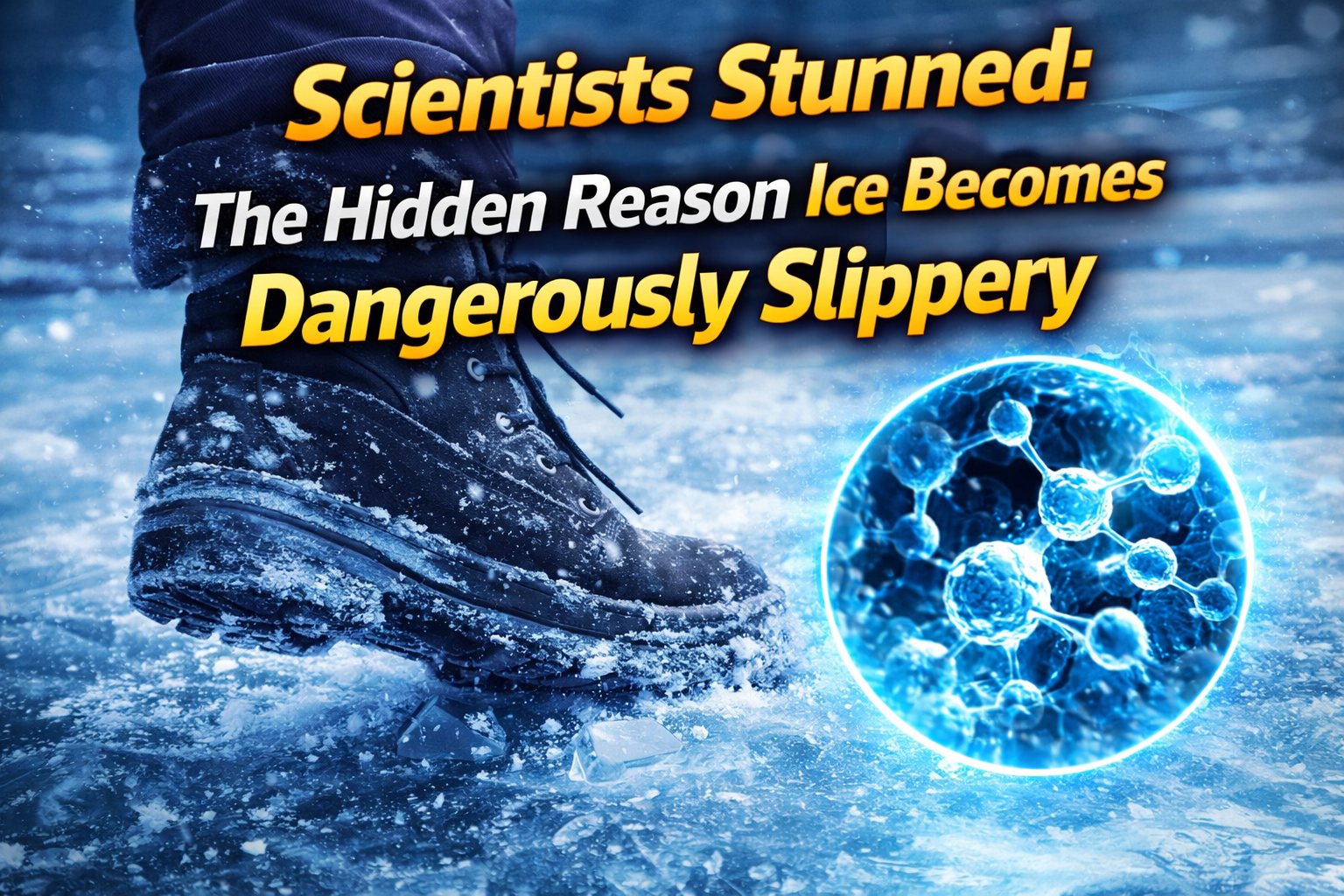
Introduction: The Mystery Behind Ice’s Extreme Slipperiness
Icy Illusion: The Surprising Scientific Secret That Makes Ice So Slippery Ice is something we encounter frequently—on winter roads, frozen lakes, and skating rinks. Yet one simple question has puzzled scientists for over a century: why is ice so slippery?
At first glance, the answer seems obvious. Many people believe that ice becomes slippery because the pressure from your foot or skate melts it, creating a thin layer of water that reduces friction. While this explanation sounds logical, scientists later discovered that the reality is far more surprising and complex.
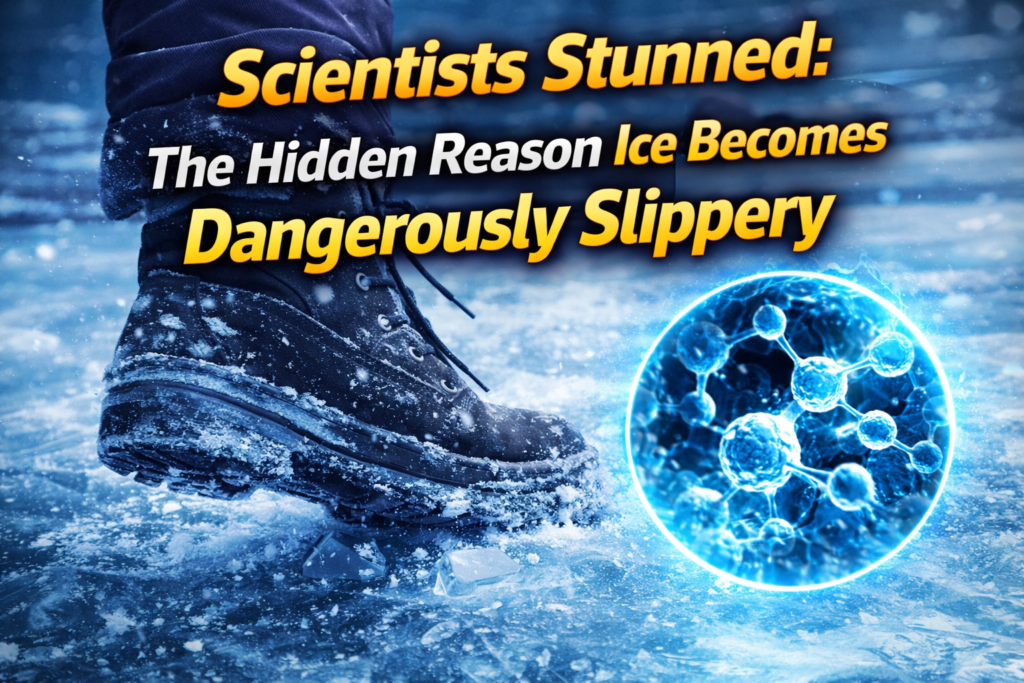
Recent research has revealed that ice has a unique molecular structure that creates an ultra-thin liquid-like layer on its surface—even when temperatures are well below freezing. This microscopic phenomenon is what makes ice dangerously slippery and difficult to walk or drive on.
Understanding the science behind ice friction isn’t just interesting—it also has important implications for transportation safety, winter sports, climate science, and material engineering.
In this article, we will uncover the shocking scientific truth about why ice is so slippery, how researchers discovered it, and why this phenomenon matters more than you might think.
What Makes Ice Different From Other Solid Surfaces?
Most solid surfaces create friction when you walk or slide on them. Friction occurs because microscopic bumps on surfaces interlock, slowing movement.
However, ice behaves differently.
Ice is a crystalline solid made of water molecules arranged in a hexagonal lattice structure. This structure is unusually flexible compared to other solids.
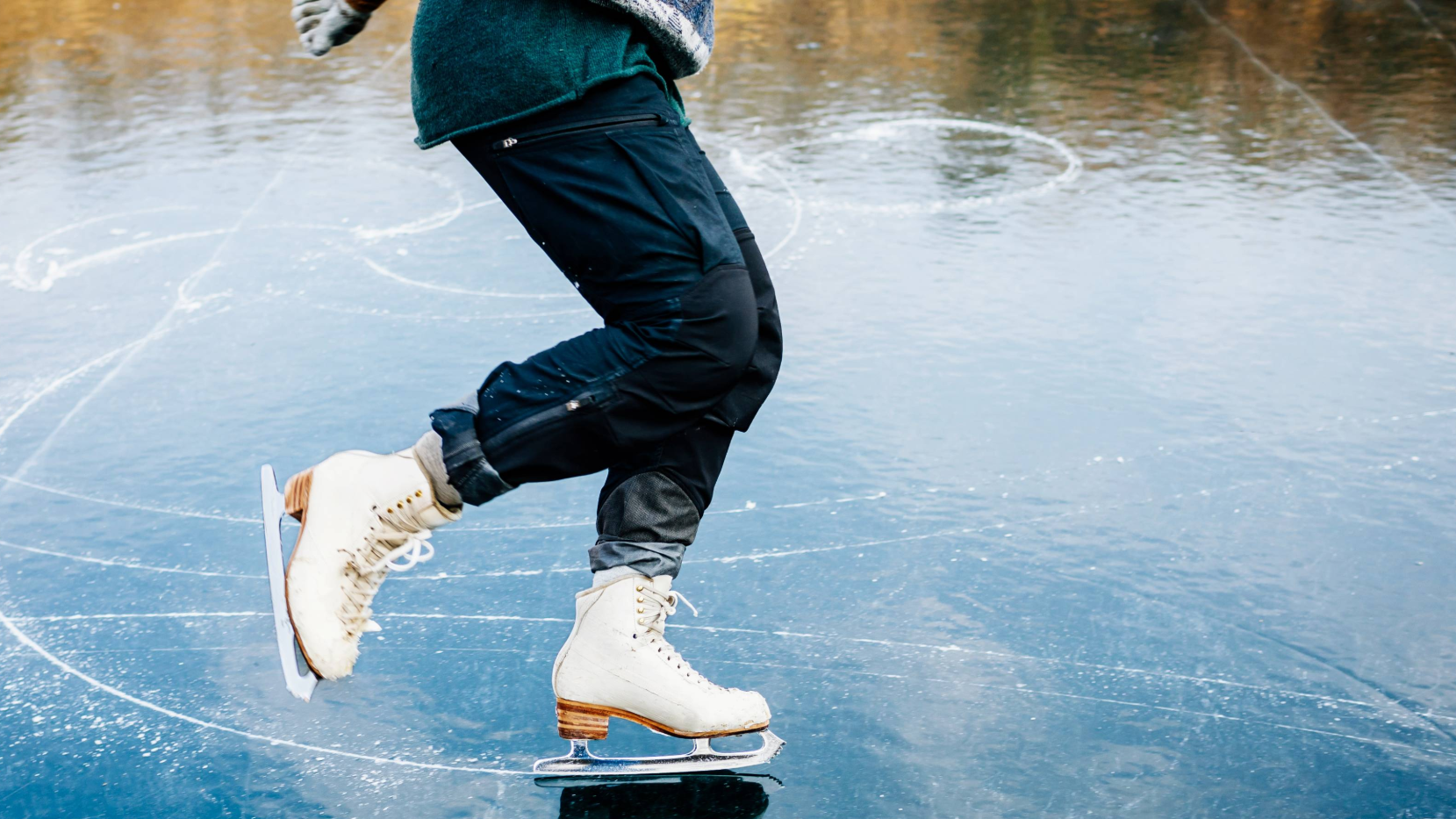
At the surface of ice, the molecules are not as tightly bonded as those inside the crystal. Because of this, they move more freely, forming what scientists call a quasi-liquid layer.
This thin layer acts like a natural lubricant, dramatically reducing friction between ice and any object touching it.
That means even when temperatures are extremely cold, the surface of ice can behave partially like a liquid.
The Old Theory: Pressure Melting
For decades, scientists believed that ice was slippery because pressure causes melting.
According to this theory:
- When a person steps on ice, their body weight increases pressure.
- Increased pressure lowers the melting point of ice.
- A thin layer of water forms beneath the foot or skate.
- This water acts as a lubricant.
While this explanation works in some cases, it has a major flaw.
Experiments showed that ice is still slippery even when the pressure is too small to cause melting, such as when someone gently touches ice with their finger.
This contradiction forced scientists to rethink the entire theory.
The Real Discovery: A Hidden Liquid Layer
Modern experiments using advanced microscopy and spectroscopy revealed something astonishing.
Even at temperatures as low as –30°C, ice still has a microscopic liquid-like layer on its surface.
This layer forms because surface molecules lack full bonding partners. Without these bonds, the molecules vibrate more and behave more like liquid water.
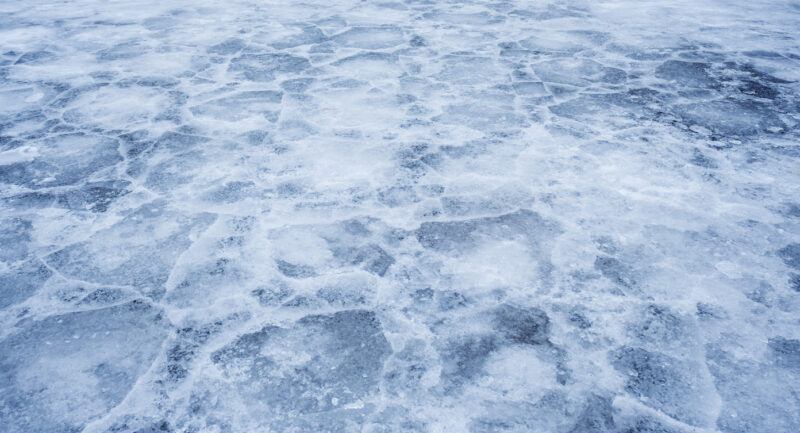
The thickness of this layer varies depending on temperature:
- Near freezing: several nanometers thick
- At very cold temperatures: extremely thin but still present
Although this layer is incredibly small, it dramatically reduces friction.
In other words, ice creates its own natural lubricant.
Why Ice Is More Slippery Than Water
Surprisingly, ice can sometimes be more slippery than liquid water itself.
This happens because the surface layer acts like a highly organized liquid film.
When a shoe, tire, or skate slides across it, the molecules rearrange rapidly, minimizing resistance.
This allows objects to glide with very little energy loss.
That’s why ice skating feels smooth and effortless compared to sliding across wet pavement.
The Role of Frictional Heating
Another important factor is frictional heating.
When something moves across ice—like a skate blade or car tire—friction generates heat.
This heat melts a microscopic layer of ice beneath the moving object.
The result is a temporary film of water that further reduces friction.
This combination of natural surface lubrication and frictional melting makes ice uniquely slippery.
Why Ice Is Dangerous for Walking and Driving
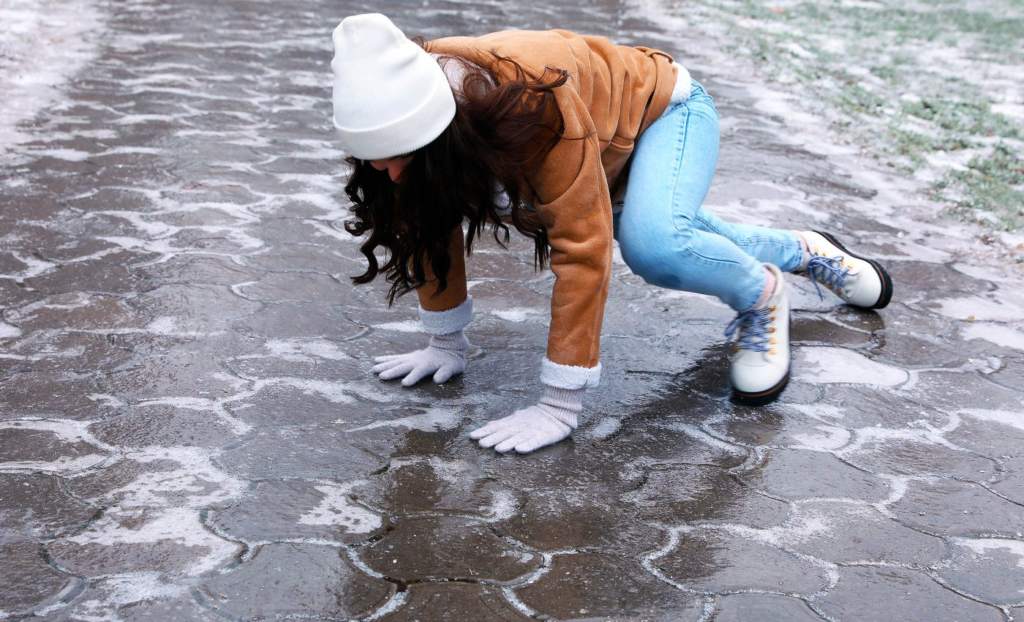
Because ice reduces friction so dramatically, it becomes extremely hazardous in everyday life.
When walking or driving, friction between surfaces provides the grip needed for stability.
On ice, that grip disappears.
Common dangers include:
- Slipping and falling
- Vehicle skidding
- Loss of steering control
- Increased stopping distances
This is why icy roads are responsible for thousands of accidents every year in cold climates.
Black Ice: The Invisible Danger
One of the most dangerous forms of ice is black ice.
Black ice forms when a thin transparent layer of ice covers dark surfaces like asphalt.
Because it blends into the road, drivers often cannot see it.
Despite being nearly invisible, black ice has extremely low friction and can cause sudden vehicle skids.
This makes it one of the most hazardous winter driving conditions.
How Ice Skating Takes Advantage of Slippery Ice
The sport of ice skating is a perfect example of how humans use the physics of ice to their advantage.
Skate blades are thin and sharp, concentrating pressure onto a very small area.
This pressure, combined with frictional heating, melts a thin layer of ice beneath the blade.
The result is a smooth glide that allows skaters to move quickly with minimal effort.
Professional speed skaters can reach astonishing speeds thanks to this phenomenon.
Why Temperature Changes Ice’s Slipperiness
Temperature plays a major role in how slippery ice becomes.
Near 0°C (32°F)
Ice is extremely slippery because the liquid-like layer is thicker.
Around –10°C to –20°C
The surface layer becomes thinner, slightly increasing friction.
Below –30°C
Ice becomes less slippery because molecular movement slows dramatically.
This is why extremely cold ice rinks sometimes require special maintenance to maintain optimal skating conditions.
Scientific Experiments That Solved the Mystery
To understand ice friction, scientists used several advanced techniques, including:
- Atomic force microscopy
- Surface spectroscopy
- Laser scanning
- Molecular simulations
These tools allowed researchers to observe the molecular behavior of ice surfaces in unprecedented detail.
The experiments confirmed that the quasi-liquid layer exists even without pressure or friction.
This discovery helped settle one of physics’ longest-standing mysteries.
Why Scientists Were Surprised
For decades, textbooks taught that pressure melting was the primary reason ice was slippery.
But modern research revealed that explanation was incomplete.
The real cause involves a combination of:
- Surface molecular instability
- Quasi-liquid layers
- Frictional heating
- Temperature effects
This complex interplay shocked scientists because it showed that ice behaves in ways unlike most other solids on Earth.
How This Discovery Impacts Modern Technology
Understanding ice friction has major practical applications.
Engineers are using this knowledge to design:
- Safer winter tires
- Anti-icing materials
- Ice-resistant airplane wings
- Advanced winter footwear
- Improved road treatments
By studying how ice reduces friction, scientists can develop technologies that improve safety in cold environments.
Climate Science and Ice Behavior
The slipperiness of ice also affects large-scale environmental systems.
For example, glaciers slide across rock surfaces partly due to thin water layers at their base.
This movement contributes to glacier flow and influences sea-level rise.
Understanding ice friction helps scientists better predict glacier dynamics and climate change impacts.
Future Research on Ice Surfaces
Scientists are continuing to explore the unusual properties of ice.
Future research focuses on:
- Nanostructure of ice surfaces
- Ice behavior in extreme cold environments
- Anti-icing materials inspired by natural surfaces
- Applications in robotics and transportation
These studies could lead to breakthroughs in winter safety and advanced materials science.
Conclusion: The Surprising Science Beneath Your Feet
The next time you step onto an icy surface, remember that an incredible molecular process is happening beneath your feet.
Ice isn’t slippery simply because it melts under pressure.
Instead, its surface naturally forms a microscopic liquid-like layer that acts as a lubricant, dramatically reducing friction.
Combined with frictional heating and temperature effects, this phenomenon makes ice one of the most fascinating materials in nature.
What once seemed like a simple everyday hazard has turned out to be a remarkable scientific mystery that scientists are still exploring today.
Understanding why ice is slippery not only satisfies curiosity—it also helps improve safety, technology, and our understanding of the natural world.
FAQs
1. Why is ice so slippery compared to other surfaces?
Ice is slippery because a microscopic liquid-like layer forms on its surface. This ultra-thin layer acts as a natural lubricant, reducing friction between the ice and objects like shoes, tires, or skates.
2. Does pressure from walking cause ice to melt?
Partially, but it’s not the main reason ice is slippery. Scientists discovered that ice already has a thin liquid-like surface layer even without pressure. Pressure and movement can add a small amount of additional melting.
3. Is ice always slippery at every temperature?
No. Ice tends to be most slippery near its melting point (around 0°C). At extremely low temperatures, the liquid-like layer becomes thinner, and the surface can become slightly less slippery.